Don't miss our holiday offer - up to 50% OFF!
Browey Portable Power Station
BROWEY portable power stations come with a foldable solar panel already built into the unit — no extra gear to buy, no separate panel to remember. That approach earned the 2022 iF Design Award, and it’s still the thing that makes people stop mid-scroll and look twice. From the 3.7 lb C150 with a hand crank for emergencies to the 1,024Wh S1600 that can run power tools and full-size appliances, three models cover everything from day hikes to multi-day blackouts. Add the 120W foldable solar panel when you need faster off-grid charging.
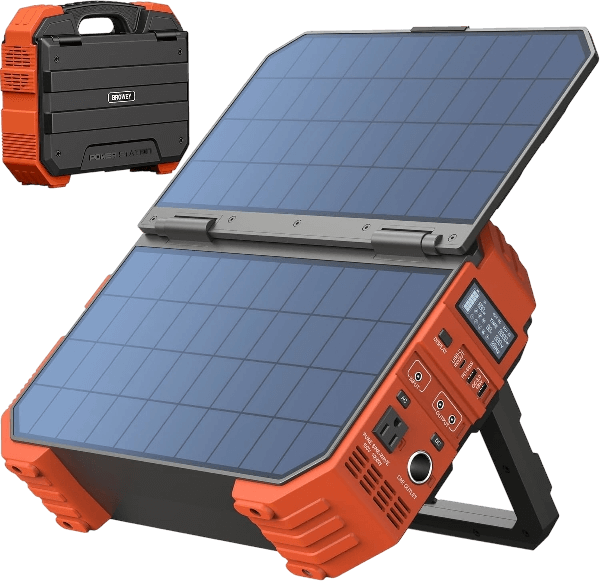
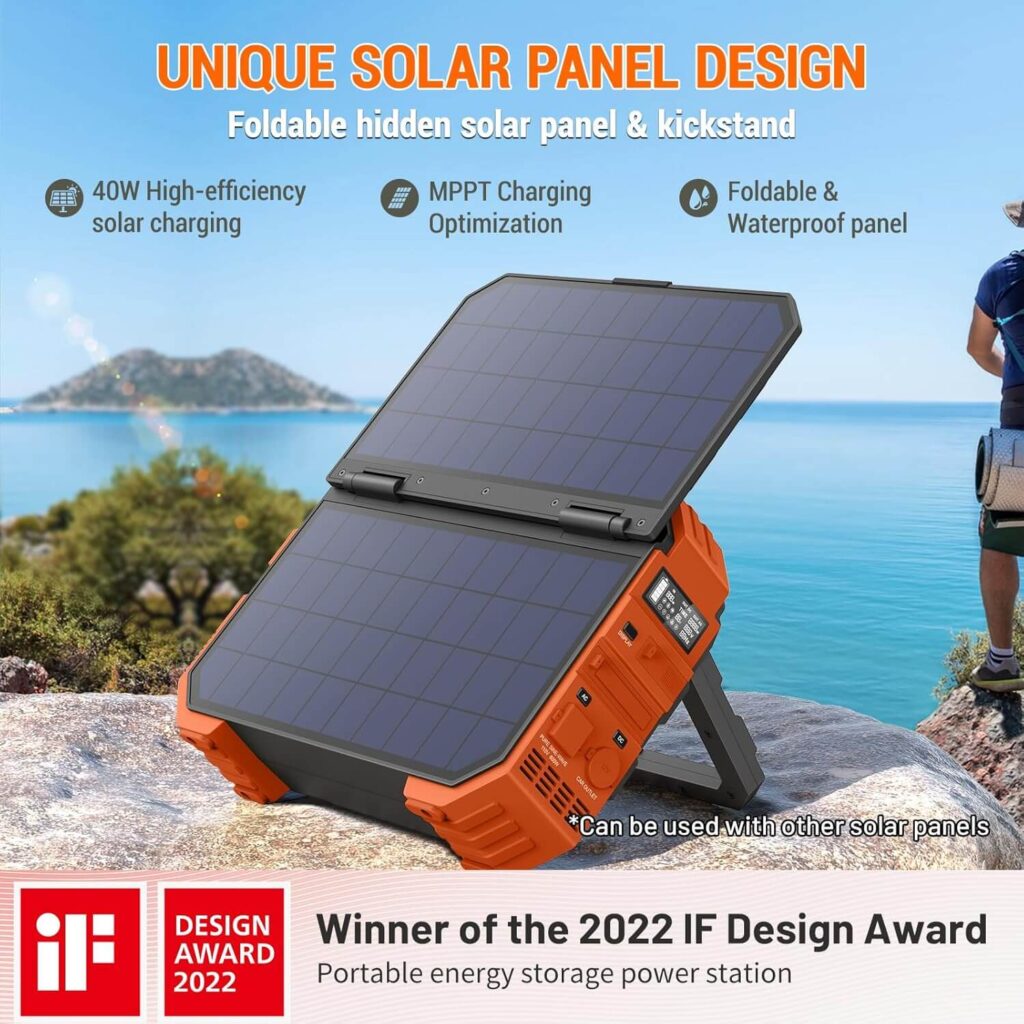
Solar Panel Already Built Right In
Most portable power stations require a separate solar panel purchase. BROWEY integrates one directly into the unit — unfold it, angle it toward the sun, and start charging.
A Battery That Outlasts the Gear
BROWEY’s S-series power stations use LiFePO4 cells rated for 3,000–3,500+ charge cycles — roughly 10 years of daily use before capacity dips below 80%.
Power the Devices That Actually Matter
The S1000 keeps a CPAP running for 8–17 hours on one charge. The S1600 handles a mini fridge, a laptop, and your phone — all at once.
Designed to Carry, Not Just to Use
Every unit ships with an accessory bag, carrying strap, magnetic lampshade, and 10 DC adapter heads. The C150 weighs 3.7 lbs. The S1000 fits in a trunk next to your cooler.
The Lineup
Three portable power stations and one standalone solar panel. Each model targets a different kind of user — pick the capacity that matches how you actually use power, then choose your color.
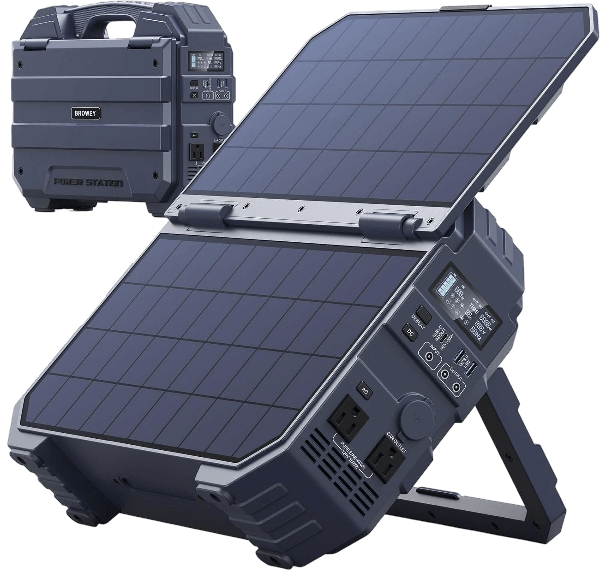
BROWEY S1600 — 1,600W Portable Power Station, 1,024Wh LiFePO4 with Built-in Solar Panel
Available colors: Dark Blue, Green
The biggest battery BROWEY makes. 1,024Wh of LiFePO4 storage paired with a 1,600W continuous inverter (3,200W peak) — enough for refrigerators, power tools, electric grills, and overnight CPAP use during multi-day outages. Built-in 40W solar panel with MPPT controller, eight output ports including 100W USB-C PD, and the full accessory kit: carrying case, strap, magnetic lampshade, 10 DC adapters, car charger cable. 26 lbs.
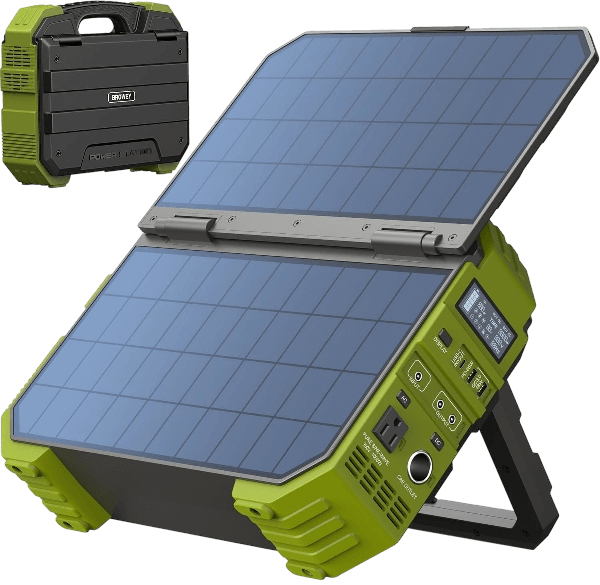
BROWEY S1000 — 1,000W Portable Power Station, 614.4Wh LiFePO4 with Built-in Solar Panel
Available colors: Dark Green, Orange
The C600’s upgrade and the sweet spot in the lineup. 614.4Wh LiFePO4 battery with a 1,000W pure sine wave inverter (2,000W surge) powers up to seven devices at once — laptops, phones, fans, CPAP machines, mini fridges. Built-in 40W solar panel, MPPT controller, and the same full accessory kit as the S1600. iF Design Award winner. 23 lbs. 4.4 stars on Amazon.
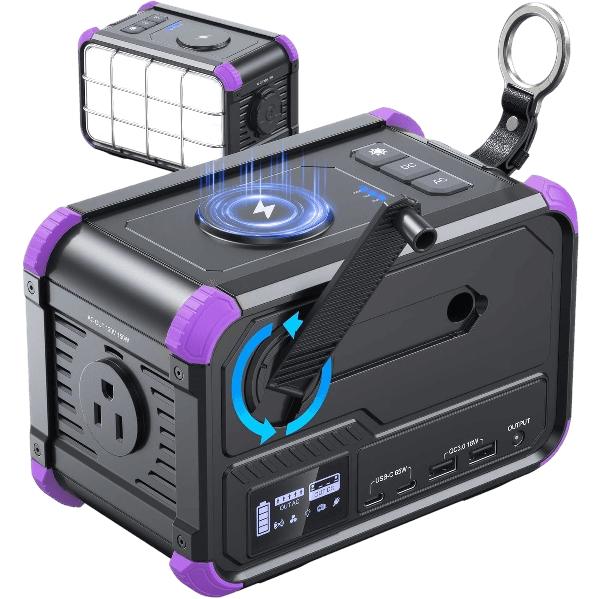
BROWEY C150 — 150W Portable Power Station, 153Wh with Hand Crank
Available colors: Green, Orange, Purple
The ultralight option. 153Wh lithium battery in a 3.7 lb package smaller than a hardcover book. 150W AC outlet, dual 60W USB-C ports, dual 18W USB-A, 15W wireless charging pad, and an emergency hand crank that delivers five minutes of LED light from one minute of cranking. Eight output ports total. LED light with three brightness levels and SOS mode. Charges fully in about three hours via PD60W adapter. No built-in solar panel, but solar-compatible through USB-C. 2-year warranty.
Which BROWEY Fits Your Life?
Not every camper needs a 26 lb power station, and not every storm-prepper can get by with 153Wh. Here’s how to match BROWEY models to the way you actually use portable power.

Day Hikes, Festival Weekends, and the Glove Box Emergency Kit
You need something light enough to toss in a daypack or keep in the car without thinking about it. The BROWEY C150 weighs 3.7 lbs and measures about 7 × 4.7 × 4.6 inches — smaller than most hardcover books. It won’t run a mini fridge, but it’ll charge your phone roughly four or five times, keep a tablet topped off, power a laptop for a couple of hours through the AC outlet, and give you LED light with an SOS mode if things go sideways. The hand crank is there for true emergencies: one minute of cranking at 2 RPM delivers about five minutes of light.
Best match: Solo hikers, festival-goers, students, anyone who wants a pocket-sized emergency backup that charges three ways — wall outlet, solar panel (via USB-C), or hand crank.
Weekend Camping with a CPAP Machine
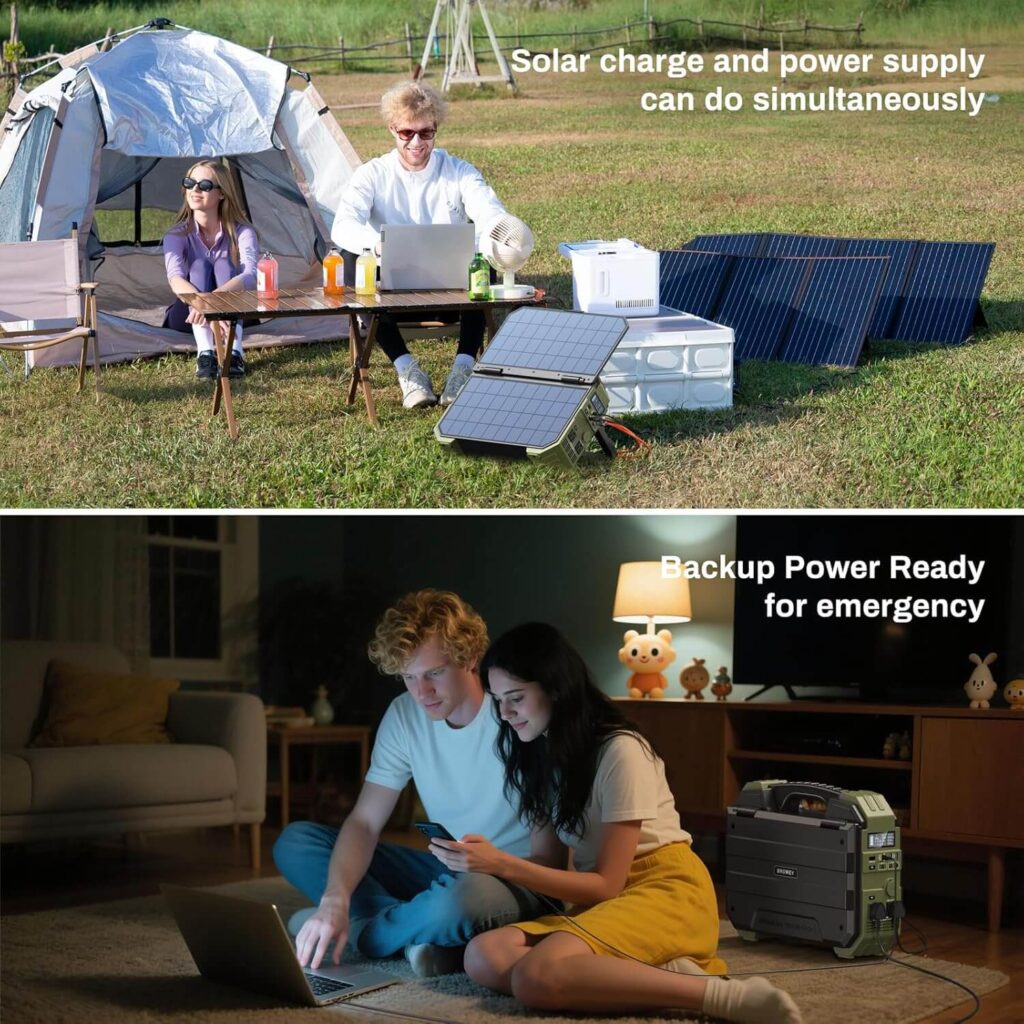
Two nights at a campsite with phones, a laptop, a fan, and a CPAP. The BROWEY S1000 handles this without breaking a sweat. The 614.4Wh LiFePO4 battery keeps a typical CPAP (30–60W draw) running for roughly 8–17 hours on a single charge — enough to cover a full night and then some. The built-in 40W solar panel tops the battery off during the day while you’re out on a trail or sitting around the fire. Seven output ports mean everyone’s devices get charged.
Best match: Couples and small families who camp on weekends, CPAP users who need reliable overnight power, and anyone building a basic storm-season kit on a mid-range budget.
Extended Off-Grid Stays, Job Sites, and Whole-Home Emergency Backup
You’re running a mini fridge around the clock, powering tools at a remote job site, or keeping essential circuits alive during a multi-day blackout. The BROWEY S1600 steps up with 1,024Wh of LiFePO4 storage and a 1,600W continuous inverter — enough to handle appliances that would trip the smaller models. The 3,200W peak surge deals with compressor startups and motor kicks. Eight output ports including 100W USB-C PD. The Green model and the Dark Blue at are identical in specs — the price difference comes down to colorway and listing.
Best match: RV and van life setups, emergency preparedness planners who take it seriously, contractors needing portable job site power, and families who want a real backup solution for storm season.
Speeding Up Solar Charging on Any BROWEY Station
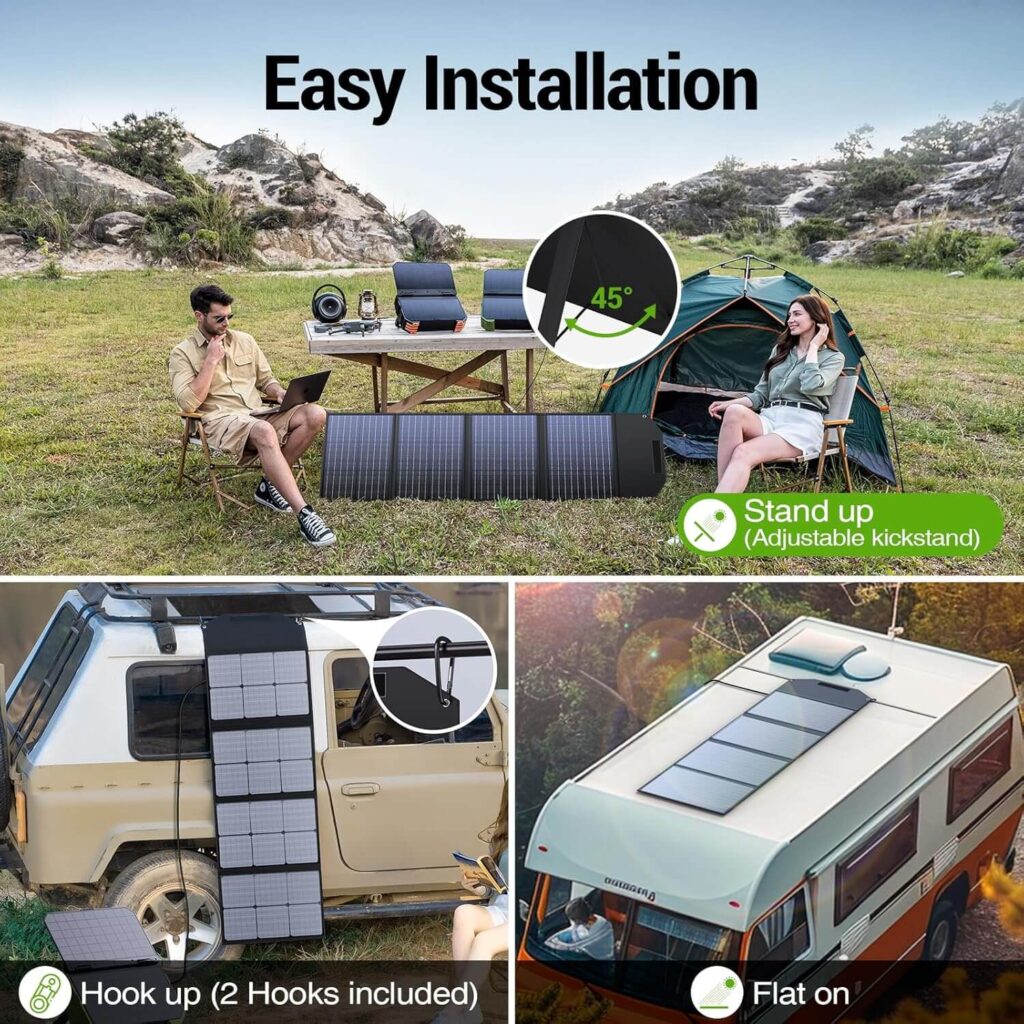
The S1000 and S1600 both have built-in solar panels, but the integrated 40W panel is a convenience and emergency feature — it’s not going to fully recharge a 614Wh or 1,024Wh battery in an afternoon. The BROWEY 120W Portable Solar Panel changes the math. It connects via DC input and delivers up to three times the charging speed of the built-in panel alone. IP68 waterproof, foldable with an adjustable kickstand, and it comes with 10 DC plug adapters so it works with most power stations on the market — not just BROWEY’s. You can also charge devices directly through its USB-C PD 45W port and dual QC3.0 USB outputs, skipping the power station entirely.
Best match: Any BROWEY power station owner who camps for more than a weekend, lives in a sun-rich region, or wants the fastest possible off-grid recharge.
Quick Selection Matrix
| Your Situation | Recommended Model | Why |
| Day trips, EDC, ultra-light backup | C150 (any color) | 3.7 lbs, hand crank, wireless charging |
| Weekend camping, CPAP, basic storm prep | S1000 (Dark Green or Orange) | 614.4Wh LiFePO4, built-in 40W solar, 1,000W inverter |
| Extended off-grid, heavy appliances, job site | S1600 (Green or Dark Blue) | 1,024Wh LiFePO4, 1,600W inverter, built-in 40W solar |
| Faster solar recharging for any station | 120W Solar Panel | IP68, foldable, 10 adapters, direct device charging |
Note: The C150 uses a standard lithium battery (not LiFePO4) and carries a 2-year warranty. The S1000 and S1600 use LiFePO4 batteries. All prices reflect listing prices at time of publication.
BROWEY Specs Side by Side
Three power station tiers and one standalone solar panel. The table below covers every model in the current lineup so you can compare the numbers that matter — capacity, output, battery chemistry, and what’s included. Below the spec table, you’ll find real-world runtimes translated into hours and charges instead of raw watt-hours.
| Spec | S1600 (Dark Blue / Green) | S1000 (Dark Green / Orange) | C150 (Orange / Green / Purple) | 120W Solar Panel |
| Capacity | 1,024Wh | 614.4Wh | 153Wh | N/A — charging accessory |
| Continuous Output | 1,600W | 1,000W | 150W | 120W (DC) |
| Peak / Surge | 3,200W | 2,000W | 300W | N/A |
| Battery Type | LiFePO4 | LiFePO4 | Lithium | N/A |
| Cycle Life | 3,000+ cycles | 3,500+ cycles | Not specified by manufacturer | N/A |
| Built-in Solar Panel | 40W | 40W | No (solar-compatible via USB-C) | N/A — this IS the panel |
| MPPT Controller | Yes | Yes | No | N/A |
| AC Outlets | Yes (120V) | Yes (110V, pure sine wave) | Yes (120V, 150W) | No |
| USB-C PD | 100W | Yes | 2 × 60W | 45W |
| USB-A | 2 × 18W | Yes | 2 × 18W | 2 × QC3.0 |
| Wireless Charging | No | No | 15W | No |
| Hand Crank | No | No | Yes (emergency use) | No |
| DC Input | DC5521, 12–30V/10A, 240W max | DC5521 | Via USB-C | DC 18V/6.67A |
| Total Output Ports | 8 | 7 | 8 | 3 (DC + USB-C + 2 × USB-A) |
| Weight | 26 lbs | 23 lbs | 3.7 lbs | Not specified |
| Dimensions | 17.1 × 13.3 × 5.5 in | 17 × 5.6 × 13 in | 7 × 4.69 × 4.56 in | 65.75 × 20.67 × 3.07 in (unfolded) |
| Waterproof Rating | Not specified | Not specified | Not specified | IP68 |
| Warranty | Per manufacturer (see Support section) | 3 years (per Amazon listing) | 2 years | Per manufacturer |
| Amazon Rating | 4.4 / 5 | 4.4 / 5 | 4.3 / 5 | 4.8 / 5 |
What Can It Actually Run?
Raw watt-hours don’t tell you much. Here’s what each BROWEY power station delivers in real-world terms, using the 85% inverter efficiency factor that accounts for energy lost during power conversion. These are estimates — your actual results will vary based on device draw, temperature, battery age, and whether you’re using AC or DC output.
| Device (Typical Draw) | S1600 (1,024Wh) | S1000 (614.4Wh) | C150 (153Wh) |
| Smartphone charge (~15Wh per charge) | ~58 charges | ~35 charges | ~8 charges |
| Laptop / MacBook Air (~50Wh per charge) | ~17 charges | ~10 charges | ~2 charges |
| CPAP machine (30W) | ~29 hours | ~17 hours | ~4 hours |
| CPAP machine (60W) | ~14.5 hours | ~8.7 hours | ~2 hours |
| Mini fridge (60W) | ~14.5 hours | ~8.7 hours | ~2 hours* |
| Camping fan (20W) | ~43 hours | ~26 hours | ~6.5 hours |
| LED camping light (5W) | ~174 hours | ~104 hours | ~26 hours |
| Portable projector (80W) | ~10.8 hours | ~6.5 hours | Not supported (exceeds 150W startup) |
| Drone battery (~60Wh per charge) | ~14 charges | ~8 charges | ~2 charges |
*The C150’s 150W continuous output and 300W peak may struggle with mini fridge compressor startups. Test before relying on it for this use case.
Math behind these numbers: Usable capacity = rated Wh × 0.85. Divide by device wattage for hours, or by device battery size (Wh) for charge count. Example: S1000 CPAP at 30W → 614.4 × 0.85 ÷ 30 = ~17.4 hours.
All runtimes are estimates. Real-world performance depends on ambient temperature (32°F–113°F operating range for S-series), battery cycle count, device-specific power draw, and whether you’re pulling from AC or DC outlets. DC output is more efficient than AC for compatible devices.
What BROWEY Owners Are Saying
“Bought the S1000 for hurricane season after losing power for three days last year. First real test came during a tropical storm — it ran my CPAP machine the entire night with battery to spare. The built-in solar panel topped it off the next afternoon. That alone justified the price.”
David R.,
Emergency Preparedness Planner
“We take the S1000 on every camping trip now. Two phones, a Bluetooth speaker, LED lights, and a small fan running through the night — still had 40% battery the next morning. The accessory bag with all the adapters is a nice touch that most brands skip.”
Jenna M.,
Weekend Camper
“I compared this to a Jackery Explorer 600 Plus for about two weeks before pulling the trigger. The BROWEY S1600 already includes the solar panel — when I added up the cost of a Jackery plus a separate SolarSaga panel, the BROWEY came out cheaper for more capacity. The green one looks great, too.”
Marcus T.,
Budget-Conscious Comparison Shopper
“The C150 lives in my van’s glove box. At 3.7 pounds, I forget it’s even there until I need it. Charged my phone five times on a long road trip and used the LED light at a rest stop. The hand crank is gimmicky for charging, but knowing it can give me emergency light is reassuring.”
Sara K.,
Van Life Enthusiast
“Got the 120W solar panel to pair with my S1000 and the difference in charge speed is noticeable. The built-in 40W panel is fine for topping off, but on a sunny weekend the external panel brings it back to full way faster. IP68 waterproof rating held up through two rainy camping trips so far.”
Tom L.,
Off-Grid Solar Camper
“My dad has sleep apnea and worries about power outages every storm season. I got him the S1600 for his birthday. He tested his ResMed CPAP on it — ran it for over 12 hours on one charge and still had power left for his phone. He sleeps easier now, literally.”
Kristen W.,
Caregiver / CPAP Household
How BROWEY Stacks Up on Total Cost
Most portable power station shoppers end up comparing three or four brands before buying. That’s smart — you should. But here’s a detail that changes the math: BROWEY stations include a built-in solar panel. Most competitors sell theirs separately, and those panels aren’t cheap.
The comparison that matters isn’t just station vs. station. It’s total cost of a functional solar-charging setup — power station plus whatever solar panel you need to go off-grid.
| What You’re Comparing | BROWEY S1000 | BROWEY S1600 | Typical Mid-Range Competitor (600–1,000Wh class) |
| Solar panel included? | Yes — 40W built-in | Yes — 40W built-in | No — sold separately |
| Separate 100W solar panel cost | Already included (add 120W external for $162 if desired) | Already included (add 120W external for $162 if desired) | $100–$300+ depending on brand and wattage |
| Total setup cost (station + solar) | $529.99–$569.99 as-is | $599.25–$631.21 as-is | $529–$899+ when panel is factored in |
| Battery chemistry | LiFePO4 (3,500+ cycles) | LiFePO4 (3,000+ cycles) | Varies — some LiFePO4, some Li-ion NMC (500–1,000 cycles) |
| Accessories included | Carrying case, strap, lampshade, 10 DC adapters, car charger cable | Carrying case, strap, lampshade, 10 DC adapters, car charger cable | Varies — often just the unit and a wall charger |
A few things to keep in mind when you’re doing your own comparison. First, look at battery type. LiFePO4 lasts three to seven times longer than standard lithium-ion per cycle count, so the upfront price tells only part of the story. A station rated for 3,500 cycles doesn’t need replacing for roughly a decade.
Second, check what’s actually in the box. BROWEY ships a carrying case, shoulder strap, magnetic lampshade, 10 DC converter adapters, a car charger cable, and a DC input cable with every S-series unit. Several competing brands at similar price points ship just the station and a wall adapter.
We’re not going to quote competitor prices here — they shift weekly, and stale numbers do more harm than good. Check current pricing on Amazon for any model you’re comparing and add up the total: station + solar panel + any accessories you’d need to buy separately. That’s the real number.
What You Should Actually Expect
Here’s the thing about portable power stations — the spec sheet and the real-world experience don’t always line up. We’d rather tell you where BROWEY’s numbers land in practice so you’re not surprised at the campsite or during an outage.
The built-in solar panel is a supplement, not a speed charger. The S1000 and S1600 both have a 40W integrated solar panel. That’s enough to trickle-charge the battery throughout the day or give you meaningful emergency power when no outlet is available. It’s not enough to fully recharge a 614Wh or 1,024Wh battery in a single afternoon. Under ideal conditions — full direct sunlight, panel angled at 90 degrees, no cloud cover — you can expect roughly 30–35W of actual output from the 40W rated panel. Solar efficiency drops with cloud cover, shade, panel angle, dust, and temperature extremes. For the S1000, a full recharge from the built-in panel alone could take several sunny days. The S1600 takes even longer. This is the reality of a compact built-in panel, and it’s why BROWEY designed every S-series unit to also accept external solar input through the DC5521 port.
The 120W external panel changes the equation. Pair the BROWEY 120W Portable Solar Panel with either S-series model and charging speed jumps dramatically. You’re pulling roughly three times the wattage of the built-in panel alone, and the MPPT controller inside the station optimizes that input. The two sources can work simultaneously — built-in panel absorbing sun while the external panel feeds through DC. The C150 doesn’t have a DC solar input, but it accepts solar charging through USB-C from compatible panels.
Inverter efficiency means you’ll use about 85% of rated capacity. Every power station loses some energy converting stored DC power to AC output. BROWEY’s pure sine wave inverter runs at roughly 85% efficiency, which is standard for this class of product. Translating that: the S1000’s 614.4Wh battery delivers approximately 522Wh of usable AC power. The S1600’s 1,024Wh delivers around 870Wh. The C150’s 153Wh gives you about 130Wh. All runtime estimates in this guide use the 85% factor.
Temperature affects battery performance. The S-series LiFePO4 batteries operate between 32°F and 113°F for charging and 14°F to 113°F for discharge. Extreme cold reduces available capacity temporarily — you might see 10–20% less runtime on a freezing night than on a mild one. The battery isn’t damaged; it just delivers less energy until it warms up. Store your BROWEY indoors during winter months when not in use.
Auto-shutoff is a feature, not a bug — but it can catch you off guard. Some owners have reported that the unit shuts off during solar charging when the draw from connected devices drops below a threshold. This is the BMS (Battery Management System) doing its job to protect the cells. If you’re relying on solar to charge while simultaneously running low-draw devices, check the display periodically to make sure the station hasn’t gone to sleep.
Portable Power for CPAP Machines
Sleep apnea affects over 30 million Americans, and for the roughly 8 million who use a CPAP machine nightly, a power outage isn’t just an inconvenience — it’s a medical concern. A portable power station with enough capacity and clean power output can keep a CPAP running through the night when the grid goes down, or let you sleep with it on a camping trip without needing a hookup.
BROWEY’s S-series power stations deliver pure sine wave AC output. That matters for CPAP machines, which contain sensitive motors and electronics that can malfunction or get damaged by modified sine wave power (the cheaper, choppy type of AC output found in some budget generators). Pure sine wave replicates the same clean electricity your wall outlet provides at home.
| CPAP Power Draw | S1600 (1,024Wh) | S1000 (614.4Wh) | C150 (153Wh) |
| 30W (low-pressure, no heated humidifier) | ~29 hours | ~17 hours | ~4 hours |
| 45W (mid-range setting) | ~19 hours | ~11.6 hours | ~2.9 hours |
| 60W (high pressure + heated humidifier) | ~14.5 hours | ~8.7 hours | ~2.2 hours |
Formula: rated capacity × 0.85 (inverter efficiency) ÷ CPAP wattage = estimated runtime in hours.
The S1000 covers a full night of sleep for most CPAP users on a single charge — even at 60W, you’re looking at close to nine hours. The S1600 gives a comfortable buffer for two nights at lower settings, or one long night with the heated humidifier cranked up. The C150 can handle an emergency nap or a few hours of use, but it’s not a reliable overnight CPAP solution for most draw levels.
A couple of practical notes. First, check your specific CPAP machine’s wattage — it’s usually printed on the power adapter or listed in the manual. ResMed AirSense 10 units draw around 30–60W depending on settings. Philips DreamStation models fall in a similar range. Second, if your machine supports DC input (some CPAP models offer a 12V or 24V DC adapter), running it from the power station’s DC outlet instead of AC skips the inverter entirely. That means better efficiency, longer runtime, and no pure sine wave concerns. Third, always test your CPAP on any portable power station before you depend on it in a real outage. Run it for a full night at home with the station unplugged from the wall and verify that the runtime matches your needs.
This section is for informational purposes only. BROWEY power stations are consumer electronics, not medical devices. Consult your healthcare provider about backup power planning for any medical equipment.
Frequently Asked Questions
How fast does the built-in solar panel charge a BROWEY power station?
The built-in 40W panel on the S1000 and S1600 delivers roughly 30–35W under direct sunlight. Expect a full recharge to take several sunny days with the built-in panel alone. Pair it with the BROWEY 120W Portable Solar Panel via DC input to cut charge time significantly. The panel is designed as a daily supplement and emergency resource, not a rapid charger.
What’s the difference between the S-series and C150 batteries?
The S1000 and S1600 use LiFePO4 (lithium iron phosphate) cells rated for 3,000–3,500+ charge cycles — roughly 10 years of daily use. The C150 uses a standard lithium battery with a 2-year warranty. LiFePO4 handles heat better, lasts longer, and retains capacity more reliably over time, which is why BROWEY uses it in the larger models.
Can a BROWEY power station run a CPAP machine all night?
Yes — the S1000 and S1600 both deliver pure sine wave AC output safe for CPAP devices. The S1000 (614.4Wh) runs a typical CPAP for 8–17 hours depending on wattage draw. The S1600 (1,024Wh) extends that to 14–29 hours. Test with your specific machine before relying on it during an outage.
Is BROWEY a legitimate brand?
BROWEY is manufactured by Shenzhen Pannizhe Technology Co., Ltd., a company with dedicated R&D, manufacturing, and after-sales operations. The brand won the 2022 iF Design Award — a globally recognized industrial design competition — for its integrated solar panel concept.
Does the BROWEY 120W Solar Panel work with non-BROWEY power stations?
Yes. The 120W panel includes 10 DC plug conversion adapters and an 18V/6.67A DC output port compatible with most portable power stations on the market. It also has USB-C PD 45W and dual QC3.0 USB-A ports for charging devices directly without a power station. IP68 waterproof and FCC/RoHS certified.
Can I charge the power station and run devices at the same time?
All BROWEY power stations support pass-through charging. Unfold the built-in solar panel (S-series) or plug into a wall outlet, and the station charges while powering your connected devices simultaneously. The BMS monitors temperature and voltage to protect the battery during pass-through use.
What does the C150 hand crank actually do?
The hand crank on the C150 is designed for emergency use only — it powers a small internal backup battery for the LED light. Cranking at 2 RPM for one minute provides about five minutes of emergency lighting. The hand crank won’t meaningfully recharge the main 153Wh battery. Primary charging happens through a PD60W wall adapter (~3 hours) or a solar panel over 100W via USB-C.
What’s included in the box with each BROWEY power station?
S-series models (S1000, S1600) ship with a carrying case for accessories, AC adapter, car charger cable, DC output/input cable, 10 DC plug conversion adapters, magnetic lampshade, carrying strap, and user guide. The C150 Orange variant includes a 5525/5521 adapter cable, power adapter, USB-C cable, and user manual. Check individual Amazon listings for exact contents per color variant.
How long do BROWEY LiFePO4 batteries last before they need replacing?
BROWEY’s LiFePO4 batteries in the S-series are rated for 3,000–3,500+ full charge cycles before capacity drops below 80% of original. One full cycle means draining from 100% to 0% and charging back up. At one cycle per day, that’s roughly 8–10 years before you’d notice meaningful degradation. The battery continues working after that point — just with reduced capacity.
What’s the operating temperature range?
S-series models charge between 32°F and 113°F and discharge between 14°F and 113°F. Cold temperatures temporarily reduce available capacity but don’t damage the LiFePO4 cells. The C150 operates between 14°F and 113°F. Store all models indoors during extreme cold or heat when not in use.
Warranty Coverage and Customer Support
BROWEY’s S-series power stations carry a manufacturer warranty, with the S1000 Amazon listing specifying a 3-year warranty. The brand’s guidelines reference a 5-year product warranty on power stations and a 10-year after-sales support commitment — check your specific listing and product documentation to confirm terms for the model you purchase. The C150 carries a 2-year warranty. The 120W Solar Panel warranty follows manufacturer terms.
Customer support is available through the BROWEY Amazon storefront, the brand website at browey.com, and email. Some early buyers noted slower-than-expected response times — a common growing pain for newer brands scaling US-based support. BROWEY has stated a commitment to lifetime technical assistance across its product line.
Every S-series unit ships with a carrying case of accessories, user guide, and all cables needed to start using the station immediately. If something goes wrong, start with the Amazon listing’s customer support contact — Amazon’s return and resolution process adds an extra layer of buyer protection.
The Story Behind BROWEY
BROWEY started with a question most power station brands never bothered to ask: why do you have to buy the solar panel separately?
A group of young engineers at Shenzhen Pannizhe Technology Co. looked at the portable power market and saw the same product repeated a hundred different ways — a box with a battery, some outlets, and a recommendation to spend another $150–$300 on a solar panel sold on a different page. So they built a power station with the panel folded right into the unit. One product, one box, ready to charge from the sun the moment you unfold it. That approach earned the 2022 iF Design Award, a globally recognized industrial design competition that evaluates thousands of entries each year. The award wasn’t for raw power specs or aggressive marketing. It was for a simple, well-executed idea: integrate the thing people need most into the thing they’re already buying.
BROWEY isn’t the biggest name in portable power. Jackery and EcoFlow have larger marketing budgets and more shelf space at big-box stores. But BROWEY didn’t set out to be the loudest brand in the room. The company puts its resources into R&D, factory-level quality control, and after-sales support — maintaining dedicated research, manufacturing, and service operations under one roof. Every S-series power station ships with LiFePO4 batteries rated for 3,000–3,500+ charge cycles, MPPT solar controllers, pure sine wave inverters, and an accessory kit that most competitors charge extra for. The newer C150 brings hand-crank emergency power and wireless charging to the ultra-portable category at a price point under $150.
The goal hasn’t changed since the first prototype: make portable power smarter, not just bigger. Build something that an engineer would be proud to explain and a first-time buyer would find easy to use. Include the solar panel. Include the accessories. Set honest expectations about what the product can and can’t do, and let people decide for themselves.